
The Indian rupee is on a roll. In 37 sessions it has appreciated 8.46 per cent from Rs 44.68 to a an American dollar to Rs 40.90 on April 26.

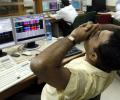
Indian equity benchmarks, Sensex and Nifty, ended lower after a spectacular rally, with the Sensex tumbling 931 points, as renewed tensions in West Asia, particularly the risk to the ceasefire deal after Iran closed the Strait of Hormuz, dampened investor optimism.

Is the current rally telegraphing a durable peace plan in West Asia, boosted by United States (US) President Donald Trump's incoherent and contradictory posts on social media?

'Travellers are considering safer and more stable destinations.'

Remittances from West Asia in March rose sharply amid the conflict in the region, with industry insiders estimating inflows to be 20-30 per cent higher than what is usual in a month.

IIT Guwahati Professor D Udaya Kumar, who designed the Indian rupee symbol, has refused to comment on the controversy surrounding the Tamil Nadu government's new rupee logo for the state budget. Kumar's father was a DMK MLA, but the professor insists it's a coincidence and he has no opinion on the state government's decision to use a Tamil letter for the rupee symbol in its budget logo.

Gold extended its record-breaking run to breach the Rs 1.5 lakh per 10-gram mark in futures trade on Tuesday, while silver surged to a lifetime high of Rs 3.27 lakh per kg as investors rushed to safe-haven assets amid mounting global tensions. On the Multi Commodity Exchange (MCX), gold futures for February delivery climbed Rs 6,861, or 4.7 per cent, to record Rs 1,52,500 per 10 grams after settling at Rs 1,45,639 per 10 grams in the previous session.
The Indian rupee is going to get the futures contract soon. The Dubai Gold and Commodities Exchange will list a futures contract on the Indian rupee in mid-June.

Foreign investors have remained cautious ahead of the Union Budget amid expectations of limited policy changes.

He was childlike with a camera in his hands -- not nave, but wonderstruck, as though the world were always on the verge of delivering something unrepeatable. Pulitzer Prize nominee Namas Bhojani recalls his long association with Raghu Rai, the legendary photographer who passed into the ages on Sunday.

Households should moderate large discretionary expenses for the time being.
'They should prioritise essential spending. They should maintain an emergency fund covering 6 to 12 months of expenses.'
'We are profoundly energy-dependent on the Gulf. That dependency must now be redirected towards the United States, because we require American permission to procure oil.' 'We additionally require Iranian permission to acquire oil from that source. So India now has to seek two separate permissions merely to secure its energy supply.' 'Should we be compelled to source from America, or from Venezuela -- which is, in effect, American-controlled supply -- that will inevitably carry a price premium, an elevated shipping cost, and a considerably extended delivery timeline, given the distances involved.'

BJP president Nitin Nabin has accused West Bengal Chief Minister Mamata Banerjee and opposition parties like the Congress for the setback in implementing women's reservation in legislatures.

CPI(M) state secretary M V Govindan has accused the Congress party of failing to deliver on its promise to construct houses for victims of the 2024 Wayanad landslide, alleging lack of transparency in funds collected and spreading misinformation about the state government's policies.

'Technology doesn't decide its destiny-humans do. We choose whether it becomes a weapon or a tool for progress.' 'Every breakthrough looks like a miracle at first, a disappointment later -- and finally, just another useful tool.'

Sri Lankan President Anura Kumara Dissanayake has announced an economic relief package to mitigate the impact of the West Asia conflict, including fuel price reductions and support from India for petrol and diesel supplies.
A yoga teacher from Surat and six others have been arrested in Ahmedabad for circulating fake Indian currency notes (FICN). Police estimate they may have circulated Rs 10 to 12 lakh in counterfeit money.

A 35-year-old man has been arrested for allegedly defrauding over 500 women across India of more than Rs 2 crore through fake social media and dating app profiles.

Delhi Police have arrested a proclaimed offender, Suresh, allegedly involved in a multi-state job scam, accused of defrauding job aspirants of crores of rupees with promises of government jobs.

Opposition leaders have criticised Prime Minister Narendra Modi's address to the nation, calling it politically motivated and a misuse of official platforms during ongoing elections.

After three consecutive months of heavy selling, foreign portfolio investors (FPIs) turned net buyers in the first week of February, infusing more than Rs 8,100 crore in Indian equities, aided by improving risk sentiment, along with a trade deal with the US.

Mcap of top 6 most valued firms drops nearly Rs 65k cr; Airtel biggest laggard

Domestic mutual funds have infused the highest ever -- Rs 4.84 trillion -- this year amid strong inflows via SIPs.

Overall economic activity continued to hold up in November with demand conditions remaining robust, thanks to strengthening urban demand, but manufacturing and rural demand showed some signs of deceleration even as services remained strong, according to an article on the State of the Economy written by Reserve Bank of India (RBI) officials in the central bank's December bulletin.

The CBI has conducted searches across multiple states in connection with a large-scale online financial fraud involving the overseas fintech platform 'Pyypl'.

Three disappointing experiences with Tata companies made me question whether the group's historic values of customer focus and accountability are slowly fading, notes Dr N Ravichandran.

'In my entire career, whenever friends, relatives, or associates have sought my counsel, I have told them consistently: Stay away from equities. Buy gold. Place funds in fixed deposits. Acquire some raw land.' 'That is all one genuinely needs to build meaningful, enduring wealth, without the attendant anxiety of equity market participation.'

Escalating geopolitical tensions in West Asia are prompting investors with exposure to Dubai's real estate market to reassess their portfolios. And, in this rejig, India is emerging as a stable destination for capital investment and long-term growth.

West Asia conflict triggers sharp sell-off in Indian markets, with realty, banking and auto stocks leading losses amid energy shock fears.
The Indian rupee will get a distinct identification symbol like the world's major currencies soon.
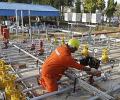
State-run oil-marketing companies (OMCs) are unlikely to significantly raise petrol and diesel prices despite crude oil nearing $100 a barrel, leading to potential margin pressure, while CLSA analysts project a 65 per cent upside for ONGC's stock.

Despite recent share price dips, Bharti Airtel is strategically positioned for growth, driven by investments in data centres via Nxtra, a potential tariff hike, and strong performance in Africa, alongside efforts to deleverage and expand its subscriber base in underpenetrated rural markets.
Foreign portfolio investors (FPIs) infused Rs 22,615 crore into Indian equities in February, marking the highest monthly inflow in 17 months, driven by factors such as the interim India-US trade deal, correction in domestic market valuations, and strong corporate earnings.
The Indian rupee has been relatively stable compared to other international currencies, Reserve Bank of India Governor Y V Reddy said on Friday.

Indian equity markets experienced a significant downturn as geopolitical tensions in West Asia, rising oil prices, and foreign fund outflows dampened investor confidence. The Sensex and Nifty both fell sharply in early trade, reflecting broader global market weakness.

Private bus operators in Sri Lanka warn of potential service disruptions and a nationwide strike due to significant fuel price increases, impacting public transport and raising concerns about inflation.

Indian stock markets tumbled sharply with the Sensex falling 800 points and nearly 4 lakh crore wiped out in a single session. Here are the 6 key factors, including rupee weakness and global cues, behind the crash.

Moody's Ratings on Friday said with a 7 per cent GDP expansion in 2025 and 6.4 per cent in the next year, India will lead growth among emerging markets and across the Asia Pacific region.

The purge in Washington does not pause the war. Strikes continue, Hormuz remains closed, and Brent crude is still dancing around $109 a barrel. For India, the command chaos in the Pentagon is another layer of uncertainty piled on five weeks of conflict that was already straining every buffer Delhi has.

The Karnataka Assembly has passed two significant bills aimed at social reform and heritage preservation: the Karnataka Freedom of Choice in Marriage and Prevention and Prohibition of Crimes in the name of Honour and Tradition Bill, 2026, and the Karnataka Jnana Bhandar Manuscripts and Digitisation Bill, 2026.
